By Reed Overfelt, CEO of Black Tiger
Every company says it wants to be “data-driven,” but few actually succeed in making data part of their DNA.
In this blog, we’ll explore what it really means to have a strong data culture, why it matters, and the practical steps you can take to build one within your organization.
What is a data culture?
Having a data culture at your organization means that decisions, strategies, and everyday actions are grounded in data rather than intuition or hierarchy. But it’s more than just collecting metrics and leaving them in isolated dashboards or spreadsheets. A true data culture is a mindset. It’s about how people think, collaborate, and act around data.
A strong data culture in action:
- Data is trusted as a reliable source of truth
- Data is easily accessible to those who need it
- Data is used regularly across all levels (from executives to frontline employees)
- Data is shared openly between teams (not locked in silos)
- Employees understand and feel confident reading, interpreting, and using data
- Data is used to drive tangible outcomes, not just reporting
- Data is collected, stored, and used responsibly, with privacy, security, and compliance prioritized
A strong data culture is mindset + access + literacy + ethical use + action. It ensures that data is not just collected—it’s understood, shared, and leveraged to make smarter decisions across the organization.
Why does it matter?
When most people hear the term “company culture,” they immediately think of the vibes, the perks, and the work environment. Their mind goes to casual Friday, free snacks, and ping-pong tables.
But true company culture is so much more than that, or at least it should be, because your company culture becomes your company.
What you prioritize, what you reward, and what you’re loud about—these quickly become part of a shared mindset that shapes the thinking, behaviors, and practices of each individual at your organization.
You want a data culture so strong that data becomes part of your team’s shared mindset. Piecemeal data use won’t deliver results. You can’t use it in solos or only here and there and expect transformation.
Keep in mind that the opposite of a data culture isn’t no data culture at all—it’s a fragile, unproductive one.
To contrast the strong data culture outlined above, let’s look at a poor data culture in action:
- Dashboards are everywhere, but no one trusts them
- Meetings focus less on what the numbers mean and more on whether they’re correct
- Data becomes a political tool, with teams cherry-picking numbers that support their agenda
- Slow decision-making that often reverts back to intuition
- Blame games erupt when outcomes don’t align with expectations
Data drives real change only when it’s embedded into your culture and, in turn, shapes thinking and workflows across the entire organization.
Challenges in building data culture
Bad data
Nothing undermines a data culture (and pretty much everything else) faster than bad data. If your data is inaccurate, incomplete, outdated, or inconsistent, it will erode trust, reduce adoption, and lead to poor decision-making across the board.
Sure, if you have bad data, you can still claim a data culture. But without good data, the culture exists in form only, not in function.
A sustainable data culture needs both the mindset and the quality data to back it up.
Lack of confidence in data
The difference between bad data and a lack of confidence in data is subtle but important. Bad data is about the quality of data itself, lack of confidence is about how your employees perceive and use the data.
Unfortunately, even high-quality data can be ignored if teams don’t trust it.
Data silos
Too often, data is locked away in silos, with isolated pockets of critical information only accessible to one team, department, or system. This leads to a myriad of issues, including that different teams may have conflicting “truths,” teams will likely waste time recreating reports that already exist elsewhere, and organizations will fail to see patterns, trends, and risks, leading to missed opportunities.
Poor data literacy
Now you’ve got good data and your people know you’ve got good data, but they don’t know how to read, interpret, and use it. This could be because they don’t understand basic statistical concepts like averages, variability, and correlation. It could be because they don’t know how to interpret charts, graphs, tables, and reports. Or it could be because they don’t know how to ask the right questions of the data in front of them.
Whatever the cause, poor data literacy leads to a culture where data exists, but it isn’t understood or applied in meaningful ways.
No shared language
When people across a company don’t have a common understanding of what key data terms, metrics, and concepts mean, they lack a shared data language.
One team’s definition of “customer” might include anyone who signed up, while another only counts those who’ve paid. One team member may cite “churn,” while another mentions “attrition,” and a third talks about “drop-off.”
Not having a shared language around data means there’s no common “dictionary” or framework for how the company defines, talks about, and uses data. As a result, even with good data available, the organization risks misalignment, confusion, and poor decision-making.
Limiting technology
Technology is often seen as the enabler of data culture, but, more often than not, it is a limiting factor. Overly complex systems limit access because only technical experts will engage with them. Fragmented systems lead to data being scattered across multiple tools, which prevents a “single source of truth.” Slow systems or systems with an inability to scale lead to sluggish queries and dashboards, which frustrate users and reduce adoption. Opaque data lineage and black-box algorithms create skepticism and often erode trust in data.
Poor accessibility
If data use is concentrated in the hands of a small group, it creates an uneven data culture where only certain functions (e.g., finance, product analytics) are data-driven, while others (e.g., HR, operations) lag behind.
Employees should be able to easily explore data, build dashboards, and run ad-hoc queries themselves. Otherwise, they disengage.
Change management & culture
Lastly, as with any transition, leaders must address the human side. Resistance, fear, unclear incentives, and a lack of support will derail data culture before it gains any momentum. Even the best data management tools and strategies will fail if people aren’t brought along in a structured, empathetic way.
How to build a data culture
Clean up your data
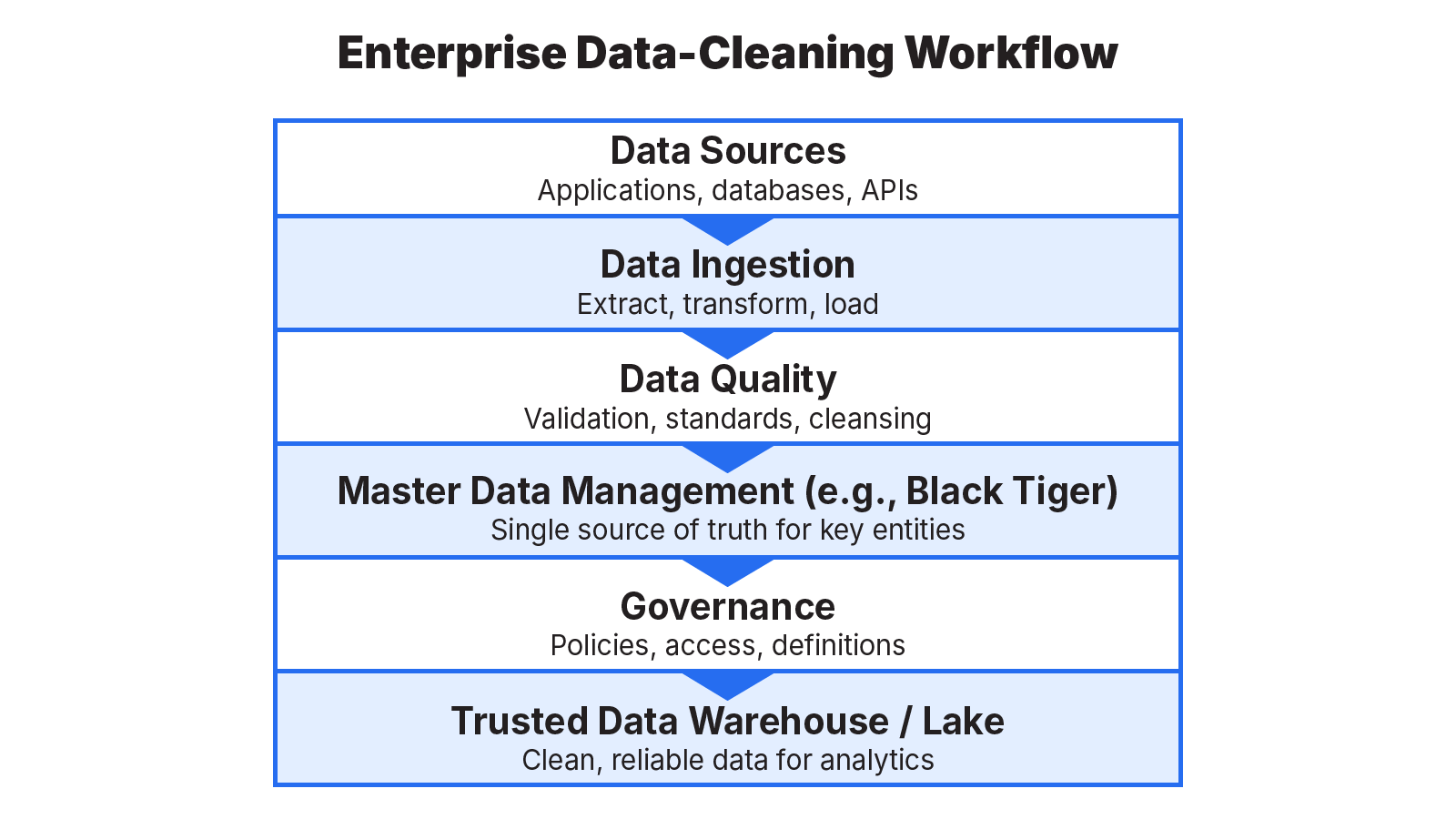
As I said above, a sustainable data culture needs both the mindset and the quality data to back it up. So, cleaning up your data—removing errors and inconsistencies, filling in missing values, flagging incomplete records, standardizing formats, validating against business rules, merging duplicate entries, removing redundant and stale records—should be your number one priority.
Cleaning up your data can feel like a huge undertaking, but with the right tools and processes, it can be done quickly and effectively. The best approach is to combine data ingestion pipelines, data quality frameworks, governance, automation, AI cleaning, master data management (MDM), and data observability into a layered approach.
Say it out loud
If being customer-centric is part of your company culture, you might review high-value customer feedback during quarterly all-hands meetings. If your company values experimentation, you’ll allocate budget, time, and tools for testing new ideas, and openly reward insights gained from experiments—even when the outcomes fail.
Just as in those cases, a strong data culture is one that is highly visible and reinforced across the organization. It’s not happening quietly in the background.
Have leaders publicly reference dashboards, metrics, and experiments in all-hands, emails, and strategy docs. Highlight success stories where data changed the course of a project, improved customer outcomes, or reduced costs. Give shoutouts to teams that challenge assumptions with data instead of gut feelings. As often as possible, you’ll want to normalize data conversations and celebrate data wins loudly so that data becomes embedded into your branding and values.
Democratize your data
Your data needs to be accessible, understandable, and usable so that everyone—from executives to frontline employees—can leverage reliable data to make smarter decisions.
First, to break down data silos and improve access, you’ll need to implement a modern master data management platform with self-service tools.
Then, you’ll want to focus on empowering your people to understand and feel confident reading, interpreting, and using data. The best way to do this is by investing in data literacy and training programs. You’ll want to build a full curriculum that covers:
- foundational topics: averages, trends, correlations, etc.
- practical skills: how to use your organization’s data toolset, how to build and interpret graphs, how to spot biased visualizations, etc.
- critical thinking: how to ask the right questions, distinguishing correlation vs. causation, recognizing data limitations, etc.
- role-specific applications: reading campaign performance for marketers, interpreting pipeline for sales, analyzing employee engagement survey results for HR, etc.
And don’t forget, true democratization requires good governance. It’s critical that you protect sensitive information and establish policies for responsible data use.
Create a shared data language
Normalizing data conversations starts with establishing a shared data language. To avoid miscommunication and conflicting reports, you want everyone to use the same definitions for critical terms.
The easiest way to do this is to create a “dictionary” or framework for how your company defines, talks about, and uses data. This dictionary should cover two key areas: Business Terms and Data Standards.
Business Terms:
- Identify the most important entities (e.g., customer, revenue, active user, etc.)
- Create clear and agreed-upon definitions.
- Document these in a data glossary that is accessible to everyone.
- Establish workflows for approving and updating terms.
Data Standards:
- Standardize how data is named, formatted, and categorized (naming conventions, codes, units of measure).
- Set clear rules for data entry and quality.
- Use MDM (Master Data Management) platforms to provide a single source of truth.
Modernize your technology
Outdated systems slow down innovation and limit agility for all teams that rely on them. Building a strong data culture requires strong data tools.
What does this look like in practice?
- Moving from on-premise to cloud platforms.
- Replacing siloed legacy systems with integrated, scalable solutions.
- Adopting self-service tools so employees can access and use data easily.
- Automating repetitive tasks to reduce costs and free up time for strategic work.
- Enhancing security with end-to-end encryption, role-based access controls, and activity monitoring to secure data both in transit and at rest.
- Improving compliance with preconfigured controls for GDPR, HIPAA, SOX, CCPA, etc.
Long-term impact of a strong data culture
A strong data culture goes far beyond just “better reporting”—it reshapes how organizations think, operate, and grow. Your teams will learn, adapt, and innovate faster and with more confidence. And, as a result, your organization will be smarter, faster, more resilient, and more innovative as a whole.
While ping-pong tables might be fun, investing in your data culture will have a far greater impact on your organization’s long-term success.